Advanced Vocabulary in High School: Strategies for College-Ready Writing
This article explains an advanced vocabulary high school approach that strengthens precise word choice and accurate spelling for college readiness writing.
Free Lesson 1 Included
Advanced vocabulary written accurately signals readiness for college-level work. In this article I show how short reads, humorous teen-friendly definitions, and image-based prompts help students infer the precise word while strengthening spelling in high school, and I include a free Lesson 1 from Spelling High School Grades 11–12 with a step-by-step walkthrough and practical tips you can use immediately.
The strategy and why it works
Teachers and parents often ask how to build deep word knowledge without overwhelming students. In Spelling High School Grades 11-12: Advanced Vocabulary and Writing Practice for College Readiness, I put this strategy into practice by blending concise reading, visual thinking, and active decision-making so learners work on meaning and form together. The approach keeps the focus on spelling priorities while steadily growing advanced vocabulary targets for college readiness writing.
1) Short “micro-reads” to reduce overload and build depth
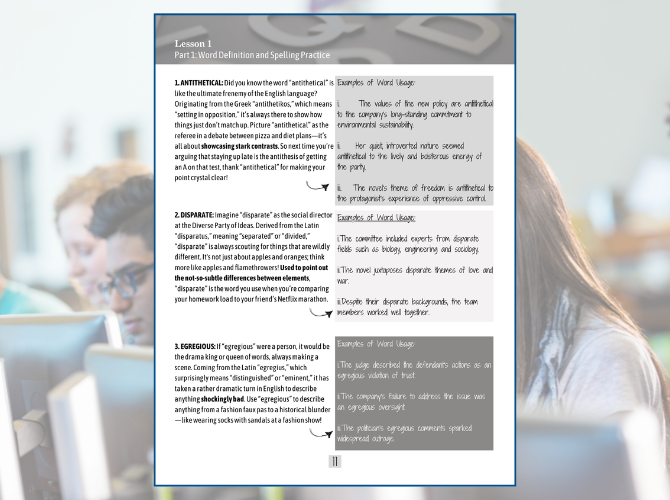
Each target word begins with a brief, purposeful explanation that highlights meaning, register, and a quick usage cue. The text is intentionally short so attention stays on what matters. This makes advanced vocabulary high school work efficient and easier to transfer into real writing.
2) Humor and teen-relevant scenarios to increase engagement
A light touch of humor and situations teens recognise improves attention and retention when it is tied to the concept. Students are more willing to use new words in authentic tasks for college readiness writing.
3) Words plus images to anchor meaning
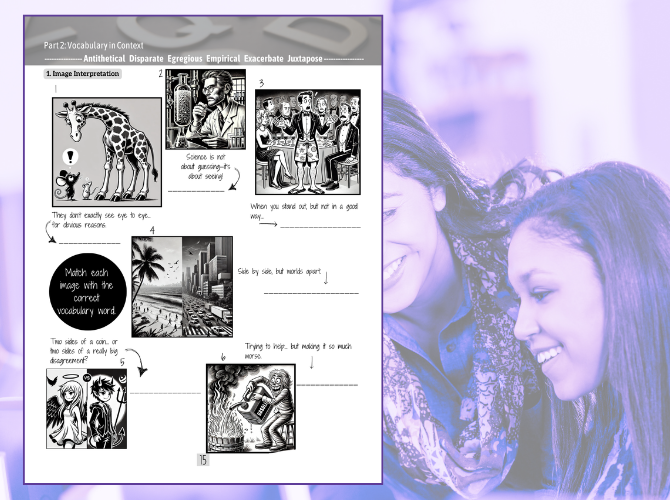
Pairing a concise explanation with a picture helps students form verbal and visual traces for a word. Images make abstract ideas concrete. Explanations supply precise language. Together, this pairing supports memory and transfer, which serves both spelling accuracy and fluent usage.
4) Inference and choice to make learning active
Students select the exact word that fits a scenario or an image, then justify the choice. This small act of analysis is also retrieval practice. Active decisions strengthen long-term recall more than passive restudy and gradually improve spelling for teenagers because they write what they decide.
5) Spelling accuracy alongside meaning
Brief syllabification and write-and-check cycles prevent near-miss errors. Precision in form supports clarity in writing and keeps spelling activities practical and connected to authentic work.
How to run Free Lesson 1 (Grades 11–12): quick guide for teachers and parents
Total time: 20 to 30 minutes in class, or 10 to 15 minutes at home
Goal: precise word choice and accurate spelling for college-ready writing
1) Warm-up before definitions
Time: 3 to 5 minutes
- Ask: “What do you think antithetical means?”
- Prompt: “What can we understand from the prefix anti?”
- Repeat with one or two more targets from the lesson.
Predict-from-examples activity:
- Have students read the example sentences first.
- Ask them to formulate their own working definition in one sentence.
- Then read the official definition and compare.
- Quick reflection: “What clue in the example helped you most?”
Parent variant: read one example aloud, ask for the meaning in the student’s own words, then check against the definition.
2) Read the definitions
Time: 4 to 6 minutes
- Students read the short, humorous, teen-friendly explanations.
- Highlight a usage cue or register note that students can imitate in formal writing.
3) Observe how the word is written
Time: 3 minutes
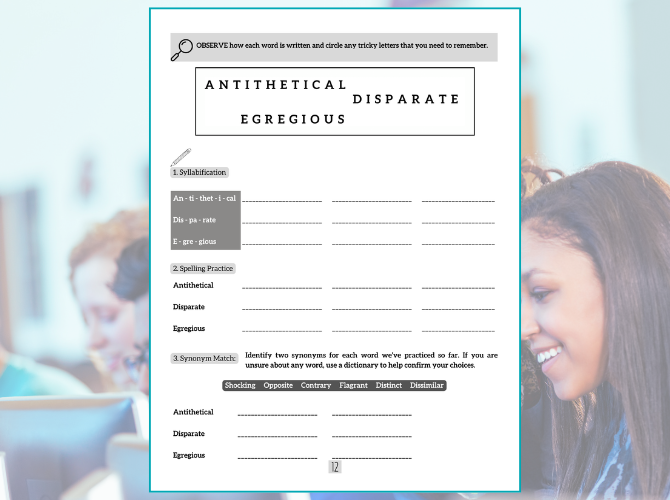
- Students mark tricky letters in each target.
Examples: the -gious in egregious, the juxta- in juxtapose, the middle pir in empirical, the thet in antithetical. - Short drill: write once, check, and notice the tricky part.
Tip for consistency: keep a small “tricky letters” list on a sticky note and look at it before any writing task this week.
4) Image interpretation
Time: 5 to 8 minutes
- Brief class look: “Describe what you see in one sentence.”
- Pairs: Student A describes the image in plain language for 60 to 90 seconds. Student B listens and matches the target word from the bank. Switch roles.
- Share one example with the group: “Which detail in the picture proves your choice?”
Why this helps: students connect a concrete scene to an abstract word, then justify the fit. This makes the word easier to retrieve in real writing.
5) Synonym match
Time: 3 to 5 minutes in class, or assign as homework
- Option A in class: students discuss in pairs and choose the best match.
- Option B homework: complete independently, then check two items together next lesson.
6) Transfer to writing
Time: 3 minutes
- Write two sentences in an academic tone using any two targets.
Prompt ideas:
- Explain a policy that is antithetical to student well-being.
- Describe two disparate data sets a researcher might juxtapose.
- Give an empirical reason that noisy hallways can exacerbate stress.
Questions or collaboration? Reach me at natasha@natashascripts.com.
