Why Practicing Spelling in High School Still Matters
Free Lesson Included
In today’s digital world, many students rely on autocorrect or predictive text. Yet when it comes to writing essays, preparing for exams, or submitting applications, correct spelling is still essential. For parents and teachers who wonder how to help, the good news is this: it’s not too late. With consistent practice and the right methods, it’s possible to improve spelling for teenagers in meaningful and lasting ways.
Why Spelling Matters in High School
Strong spelling skills not only shape grades but they influence how clearly students can express themselves, how their work is received by teachers, and even how confident they feel when presenting ideas. In college applications and job contexts, errors can create a poor first impression. Developing spelling high school proficiency ensures that students are prepared not only for academic success but also for real-world communication.
In my books Spelling High School Grades 9–10 and Spelling High School Grades 11–12, I show how structured lessons can help teenagers build these skills step by step.
It’s Not Too Late to Improve
Some parents worry that if their teenager is still struggling with spelling, the window has closed. In fact, the teenage years remain a prime stage for developing language skills. With daily exposure, repeated practice, and supportive instruction, students can quickly identify patterns, overcome weak spots, and make noticeable progress. Consistency is more important than perfection.
Spelling Practice in Class and at Home
Practical, short routines are the most effective. Teachers can use high school spelling activities such as:
- Five-minute warmups focusing on key words.
- Peer correction tasks using real passages.
- Quick syllable drills that highlight spelling patterns.
At home, parents can encourage teenagers to:
- Keep a personal error log of frequently misspelled words.
- Read short passages aloud and write down new vocabulary.
- Use flashcards or simple digital tools for reinforcement.
- Write weekly reflections applying new words in context.
These methods don’t have to take long; even ten minutes a day can make a difference.
A Walkthrough of Lesson 1: Spelling High School Grades 9-10
To see how this approach works in practice, let’s look at Lesson 1 from Spelling High School Grades 9–10. The lesson demonstrates how spelling is taught through context, structure, and application.
1. Target Word List
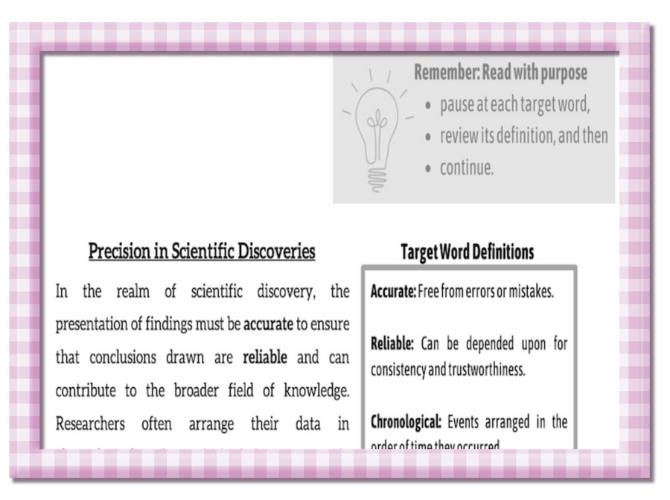
Students begin with a set of focus words: Accurate, Reliable, Chronological, Context, Convey, Rigorous, Accessible. Each is defined and later embedded in meaningful passages.
2. Reading in Context
Rather than memorizing isolated lists, students encounter the words in a short paragraph, where accuracy and reliability are highlighted as part of real-world communication. This helps students connect spelling to purpose.
Get Lesson 1 (Free)
3. Syllabification Drills
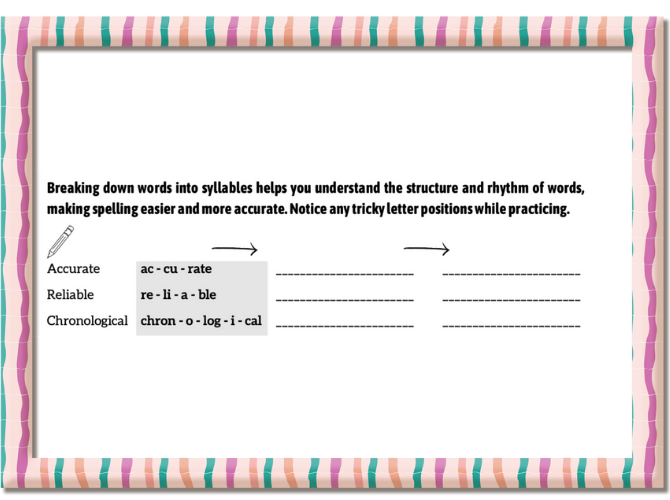
Words are then broken into syllables (ac-cu-rate, re-li-a-ble, chron-o-log-i-cal). This reinforces correct spelling patterns and pronunciation, which is especially useful for longer, more complex words.

4. Application Activity
Students read a fictional but formal letter, The Discovery of Atlantis, and answer comprehension questions using the target words. For example:
- How can you determine if this document is accurate and reliable?
- What historical context does it refer to?
This integrates spelling, vocabulary, and critical reading.

5. Error-Spotting Exercise
Next comes The Great American Pizza Quest—a lighthearted article containing deliberate spelling mistakes (e.g., riegorously, reiliable, acessible). Students must detect and correct them. This task mirrors the proofreading they’ll need in academic and professional settings.
6. Reflection and Goal Setting
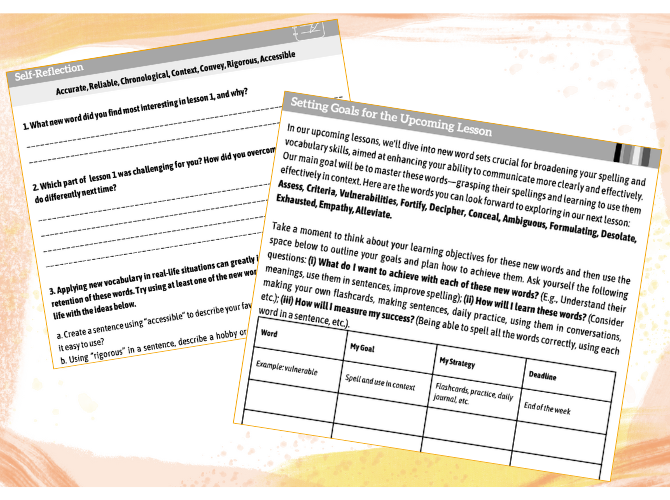
Finally, students write their own sentences using the new words, reflect on what challenged them, and set personal goals. For instance:
- “I will practice spelling and using accessible in three sentences by Friday.”
This closes the loop by turning practice into ownership.
Through this single lesson, students move from introduction → practice → application → reflection. It’s a model of how structured spelling instruction can engage teenagers meaningfully.
Building Confidence through Spelling
Every time a student successfully masters a difficult word, they gain not only knowledge but also self-assurance. Spelling practice reduces anxiety in timed essays, improves fluency in written expression, and contributes to a sense of academic competence. Over time, these small victories build resilience and encourage teenagers to take pride in their work.
Interactive Online Games
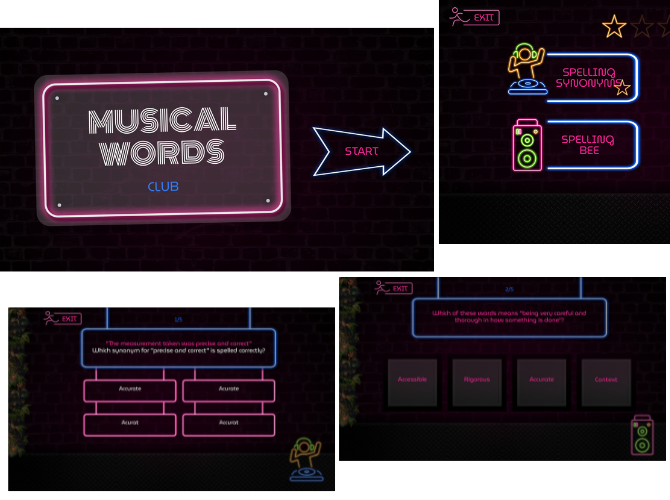
To consolidate learning, students can play an online game linked at the end of the lesson. In Lesson 1, the activity is Musical Words, where students match spelling practice with rhythm and timing. This gamified approach helps students enjoy spelling practice and reinforces their recall in a different format.
Next Steps and Resources
If you’re a teacher or parent, you can try Lesson 1 directly with students. It offers a complete cycle of reading, spelling, and application that shows just how effective high school spelling activities can be.
For a full program of lessons, explore my two books:
Both are designed to help students steadily improve spelling for teenagers, while also enhancing vocabulary and writing skills.
Get Lesson 1 (Free)
