How to Use the Frayer Model for Vocabulary in Middle School
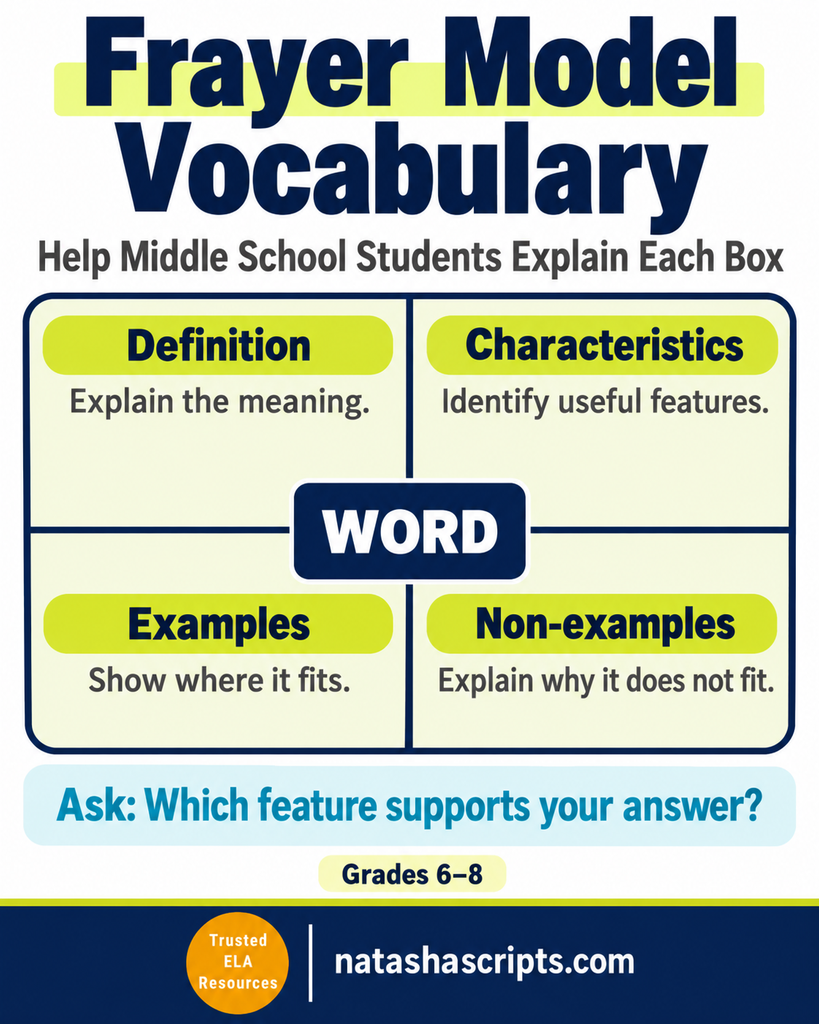
The Frayer model is a graphic organizer with a box in the center for the vocabulary word and four surrounding boxes for its definition, characteristics, examples, and non-examples. Students use these sections to explore what the word means and how it applies to particular objects, actions, or situations.
I find the combination useful because each section gives us something to discuss. We can begin with a definition, consider the features associated with the word, and then use examples and non-examples to explain it more fully. For middle school students, this can be a useful vocabulary activity across English, science, mathematics, and other subjects.
Before asking students to complete the organizer, explain what belongs in each box and work through a word together. The following suggestions show how you can approach the four sections and adjust the amount of information you provide.
1. Finding and Discussing the Definition
I recommend beginning with a short passage containing the vocabulary word. This gives students a particular use of the word to consider when discussing its meaning.
For example, you might provide this passage:
The men had a nefarious plan. They would collect money for a school library, keep it for themselves, and disappear before anyone discovered the theft.
The details suggest that nefarious describes something deliberately wrong or criminal. Students can use those details to suggest a meaning, write it in the definition box, and then check a dictionary. If the passage does not provide enough information, give them the meaning or look it up together.
A dictionary can also be the starting point, particularly when there is no accompanying passage. Students can copy the relevant definition into the box. The teacher or parent can then discuss the wording with them and explain unfamiliar terms within the definition itself.
Some dictionary entries give several meanings. Read these together and identify the one that fits the passage or lesson. With a word such as bank, for example, the surrounding sentences will help establish whether it refers to a financial institution or the land beside a river. Record the meaning you are studying in this organizer.
2. Choosing Characteristics That Explain the Word
Characteristics are features or qualities that help describe what we are studying. What students write here will depend on the word.
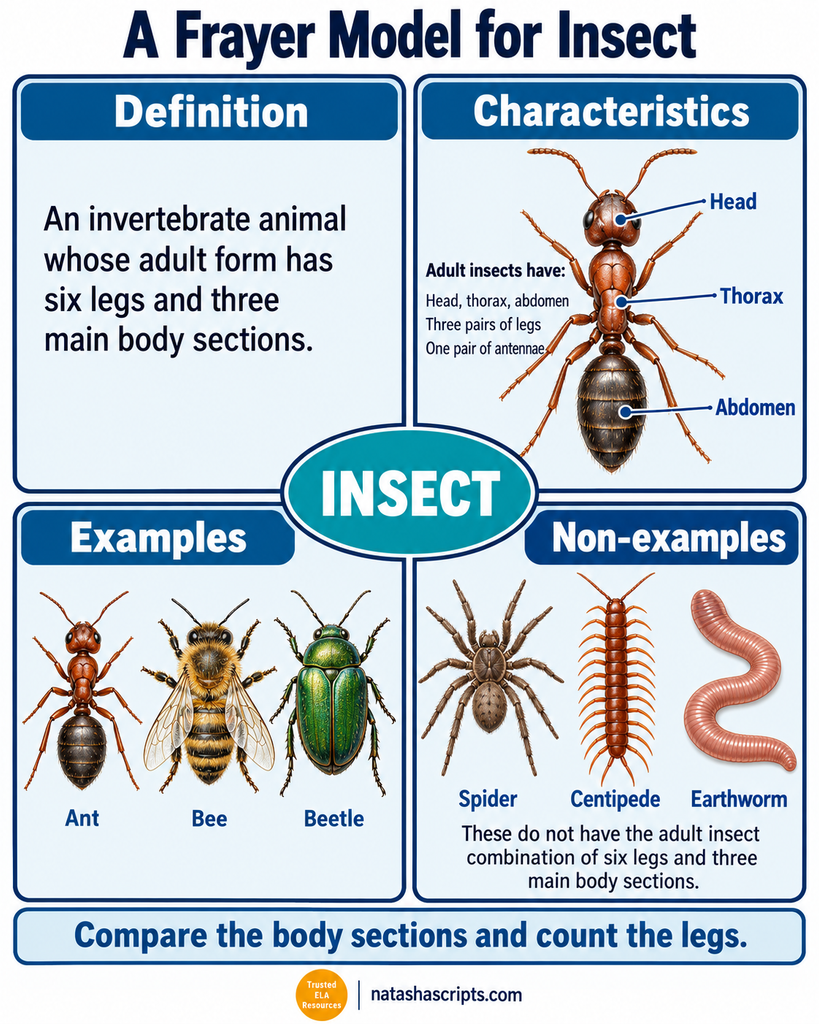
For insect, the characteristics can be quite specific: adult insects have six legs and three main body sections, the head, thorax, and abdomen. These features will help students decide which animals belong in the examples box.
For nefarious, the discussion is different. Students might record that it has a strongly negative connotation, describes wicked or criminal behavior, and can be used to describe plans or activities. Here they are considering the associations and use of the word.
There may be some overlap with the definition. A student who has written “wicked or criminal” in the first box may explain in the characteristics box that a nefarious action involves deliberately doing something wrong. That is a reasonable contribution to discuss and develop. We can ask them to connect it with the plan in the passage or add another observation about how the word is used.
I would allow this flexibility when using the organizer for general vocabulary. For a scientific or mathematical concept, we should give more attention to the precise features that determine which examples fit. Six legs is an important distinction when we are comparing an adult insect with a spider.
3. Giving Examples of the Word
The examples box asks students to identify something that fits the meaning. The answer can be a word, a picture, or a sentence, depending on the vocabulary being studied.
For insect, students can write ant, bee, and beetle, or draw and label them. These are examples of insects, so a complete sentence is unnecessary.
For nefarious, a brief description of an action or situation gives us more to work with:
A group collects money for a school library and secretly keeps it.
This describes a particular dishonest action. “Something wicked or criminal” would explain the definition again without giving an example. Students can use the original passage when completing the first organizer together, then suggest a different situation when they are ready to work independently.
If you ask them to write a sentence using the vocabulary word, explain that the sentence should show its meaning. “They had a nefarious plan” leaves the plan unexplained. Adding what they intended to do gives the reader enough information to understand the choice of word.
4. Explaining Non-Examples
I would spend a little more time discussing non-examples, as this section can be the most difficult to explain. A non-example gives us something to compare with the word we are studying. It may be an opposite, or it may share some features with the concept without meeting its definition.
I prefer to begin with familiar objects or categories so students can see the connection. For insect, I might use a spider as a non-example. Both are small animals with several legs, and students may already think of them as belonging to the same group. We can then look more closely: a spider has eight legs, while an adult insect has six. The spider belongs in the non-examples box because it does not have the characteristics of an insect.
We can also use shapes to explain the distinction. Triangles, squares, and hexagons are all polygons. They are two-dimensional shapes with straight sides that join to form a closed figure. A circle is also a two-dimensional shape, so there is a clear connection, but its boundary is curved. It therefore does not meet the definition of a polygon.
An open zigzag line gives us another comparison. It is made from straight line segments, as a polygon is, but those segments do not form a closed figure. This time, being open is the feature that makes it a non-example. Looking at a drawing of each one helps students see why the circle and zigzag belong in a different box from the triangle, square, and hexagon.
Opposites can also be useful when they give students a meaningful comparison. For nefarious, I could return to the passage about collecting donations. Keeping the money is an example of dishonest conduct. Using all the donations to buy the promised library books is a non-example of nefarious behavior because the group has acted honestly.
In each case, I want students to explain the connection and the difference. This gives us a reason for choosing the non-example and brings us back to the meaning and characteristics of the word.
Putting the Four Sections Together
A completed organizer for insect could contain:
- Definition: An animal belonging to a group of invertebrates whose adults have six legs and three main body sections.
- Characteristics: Adult insects have a head, thorax, and abdomen, three pairs of legs, and one pair of antennae.
- Examples: Ant, bee, beetle.
- Non-examples: Spider, centipede, earthworm. These animals do not have the combination of six legs and three main body sections found in adult insects.
Discuss the examples alongside the characteristics so students can see how the sections connect. A picture can be particularly useful here: students can count the legs and identify the body sections rather than relying only on the written description.
A More Guided Frayer Model Activity
You can prepare a partially completed Frayer model to suit the lesson. Select the vocabulary words and a passage, provide the definitions, and discuss the characteristics together. Students can then complete the examples box themselves and explain their choices. Non-examples can be provided for discussion or developed together.
Another activity I like to use in class involves cards. Prepare cards with the vocabulary words and their definitions, then ask students to match them and place each word in the center of an organizer and its definition in the appropriate box. You can also provide characteristics and non-examples on separate cards for students to discuss and place. Leave the examples box empty so they can contribute their own examples after considering the information provided.
The cards allow students to move an answer and reconsider a match during the discussion. Once they have agreed on the placement, they can copy or attach the cards to the organizer and add their examples.
The amount of support can change as students become familiar with the activity. You may begin by supplying most of the information, then leave additional sections for them to complete. Keep time for discussion so students can explain their entries, ask about unfamiliar meanings, and revise an answer when needed.
Using a Reading Passage for the Activity
The passages in my book 7th Grade Vocabulary: 36 Weeks of Reading Passages and Word Activities can provide a starting point for this work. Although the book does not use the Frayer model, you can select a passage and choose a few of its vocabulary words to study with the organizer.
Read the passage together before beginning. Students can return to the sentences containing each word when discussing the definition, then develop the other sections with the support they need. This allows you to add a Frayer model activity to the reading and vocabulary work you are already doing.
Free ELA Resources
For additional reading passages and vocabulary practice, you are welcome to explore my Free ELA Resources page, where I share sample lessons from my books. You can review the samples and select material suited to the words and skills you would like to work on with your students.
