Homophones and Tricky Spelling Words for Middle School
Homophones and Tricky Spelling Words for Middle School
Homophones often remain a source of confusion in middle school writing. Students may recognize familiar pairs when they see them together but still select the wrong spelling when writing independently.
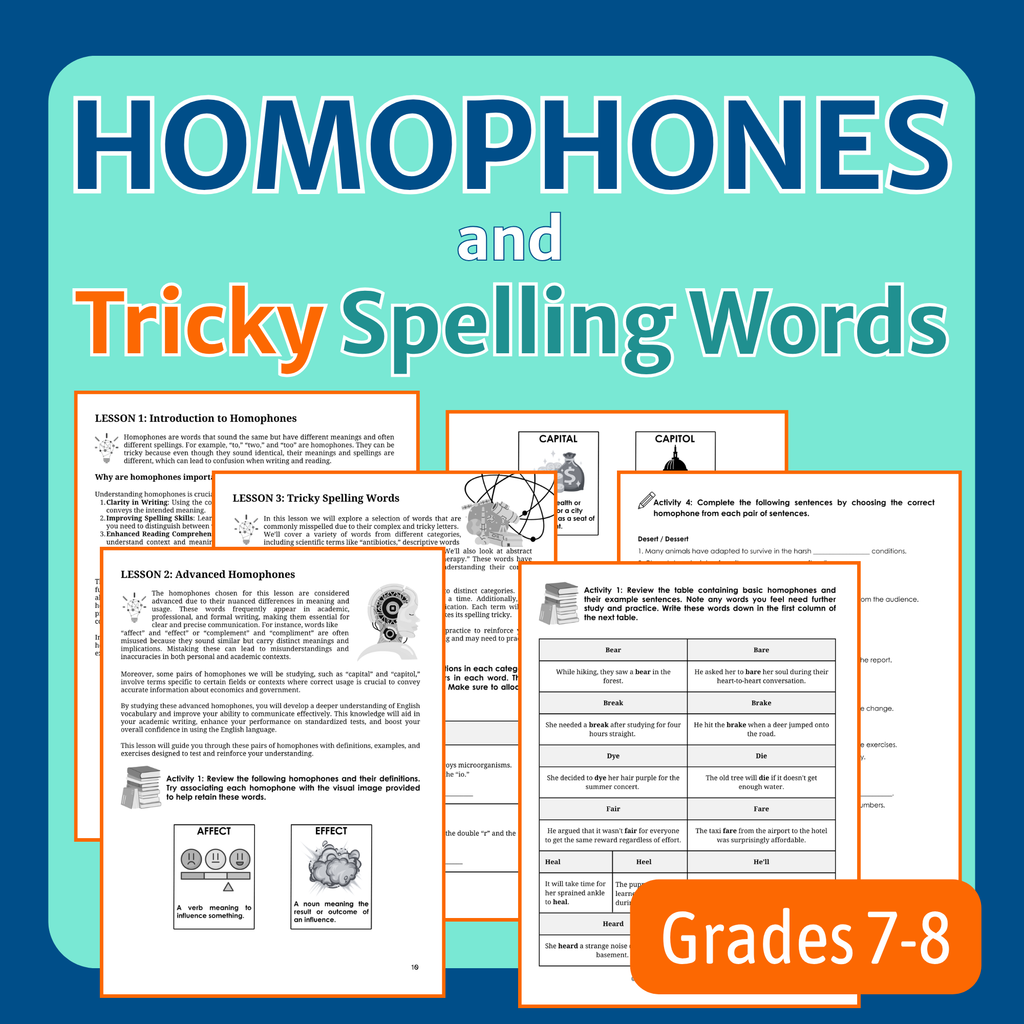
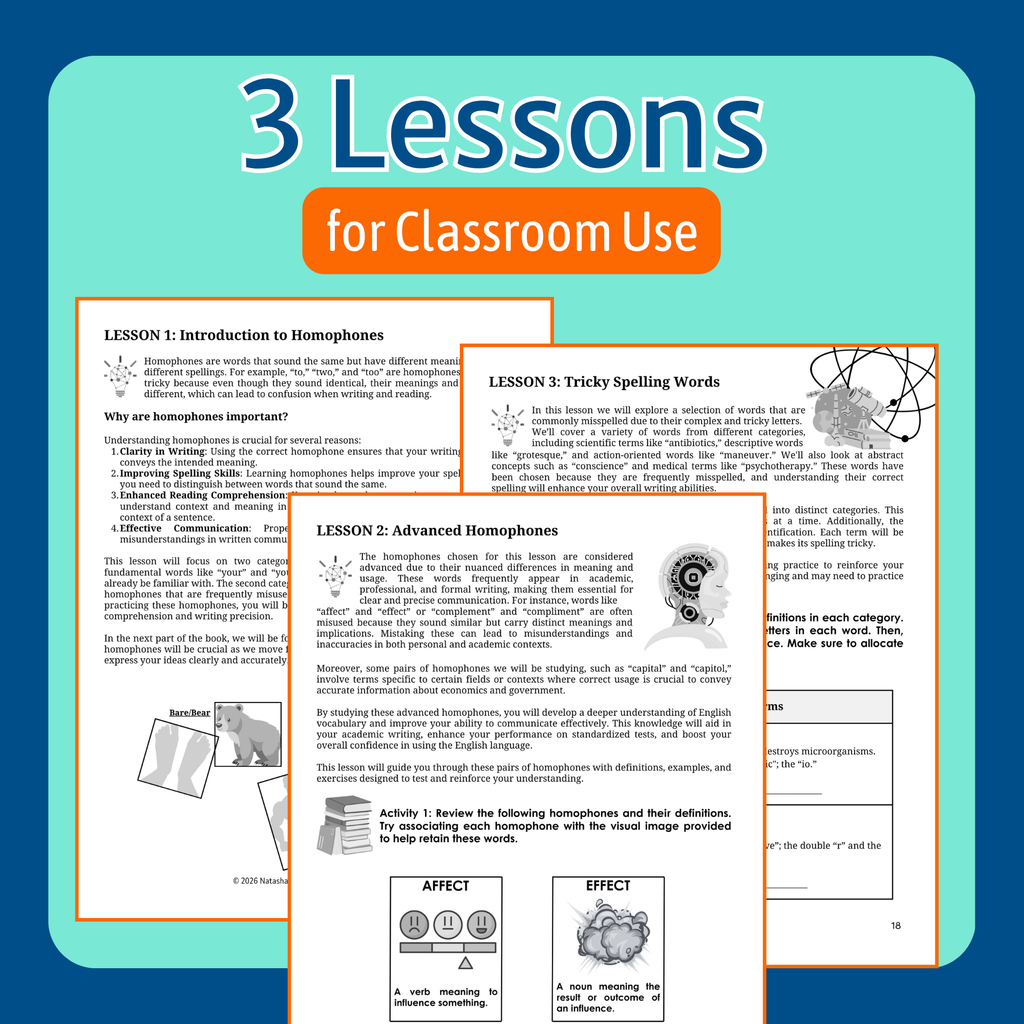
This printable three-lesson resource helps students distinguish between common and advanced homophones before extending their word study to more challenging spelling words. Definitions, example sentences, visual associations, and written practice help students connect each word’s spelling with its meaning and use.
The Three-Lesson Sequence
Lesson 1: Introduction to Homophones
Students begin with familiar homophones such as bear/bare, whole/hole, there/their/they’re, and your/you’re. A detailed reference table provides examples in context. Students then select words they find difficult, record their meanings, and use them in original sentences.
Lesson 2: Advanced Homophones
Students study more challenging word pairs, including:
- affect/effect
- capital/capitol
- complement/compliment
- principal/principle
- coarse/course
- accept/except
- stationary/stationery
- desert/dessert
- elicit/illicit
- ensure/insure
- further/farther
- precede/proceed
- device/devise
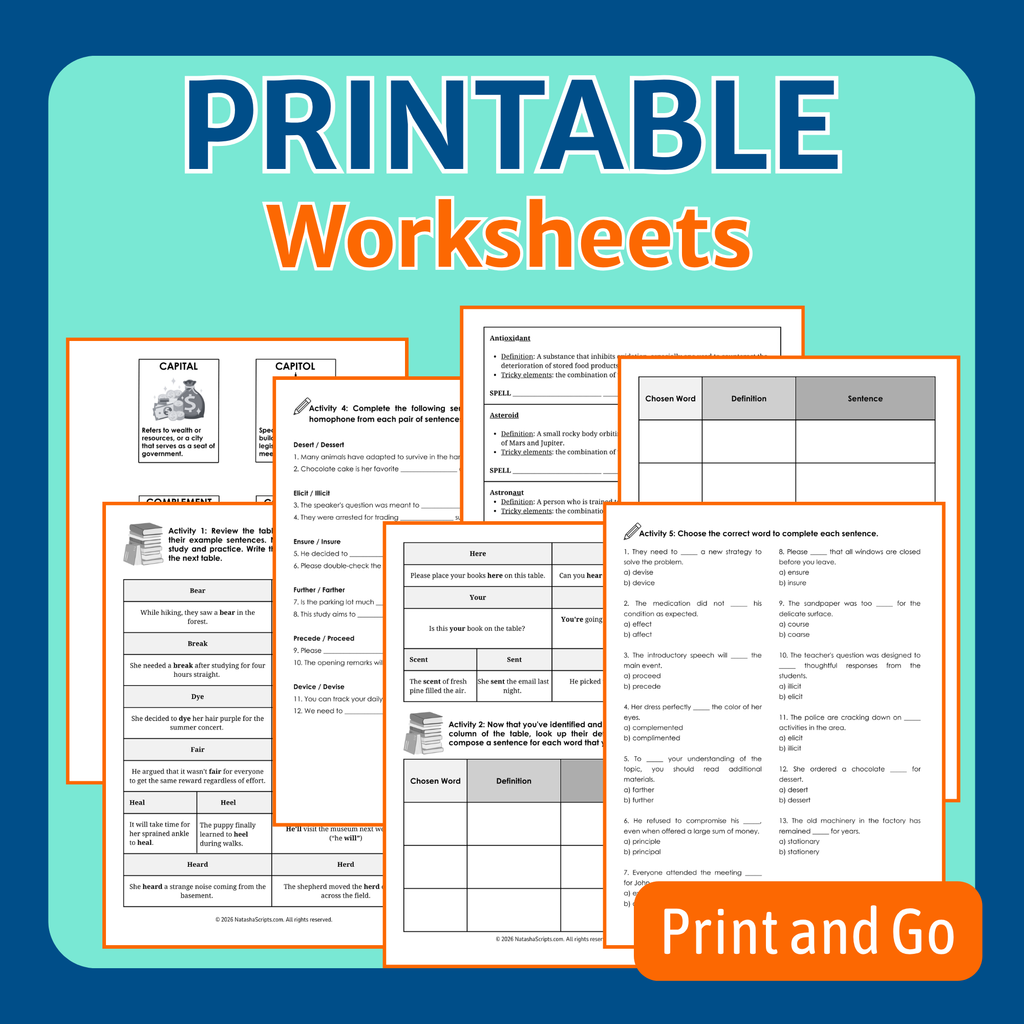
Visual associations, definitions, and examples are followed by sentence-completion and multiple-choice activities.
Lesson 3: Tricky Spelling Words
The final lesson introduces 26 challenging words organized into scientific and technical, medical, abstract, descriptive, and action-oriented categories. Each entry includes:
- a concise definition;
- an explanation of the difficult spelling elements;
- space for repeated spelling practice.
Words include antioxidant, synchronize, pneumonia, psychology, conscience, equilibrium, pseudonym, subtlety, accessible, poignant, surveillance, and maneuver.
Flexible for Classroom or Home Use
The lessons may be taught consecutively as a short word-study unit or selected individually according to students’ needs. Classroom teachers can use the reference pages for whole-class or small-group instruction before assigning the activities independently. Homeschool parents can divide each lesson into shorter sessions with time for discussion and review.
The reference pages can also be retained for later use during writing, proofreading, and editing.
What Is Included
- One printable PDF
- 24 pages in total
- Three complete middle school lessons
- Homophone reference tables
- Visual word associations
- Sentence-completion and multiple-choice practice
- Definitions and spelling guidance for 26 challenging words
Recommended for: Grades 7–8, middle school ELA, spelling intervention, word study, writing support, independent practice, homework, and homeschool instruction.