Synonym Mistakes Middle Schoolers Make and How to Address Them
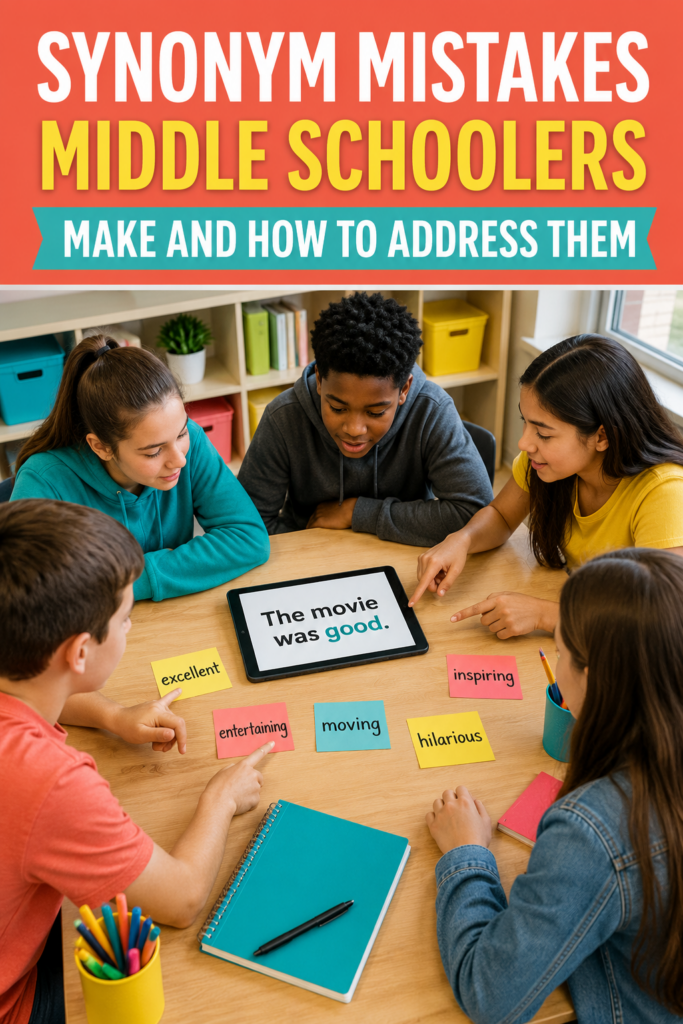
When middle school students begin using a thesaurus or a specialized synonym list in vocabulary instruction, a particular pattern tends to emerge in their writing. Words get swapped in without much consideration of how they function in context, and the result is writing that sounds slightly off, or occasionally quite wrong, even when the substituted word is technically related in meaning to the original. This pattern is common across grades 6 through 8 and reflects an important stage in vocabulary development.
The underlying issue is that synonyms are rarely perfect equivalents. Two words may share a general meaning and still differ in tone, register, formality, connotation, or the grammatical contexts in which they naturally appear. A student who understands that happy and elated are synonyms has learned something useful, but if that student writes “She felt elated about her new pencil case,” the word choice creates a mismatch between the intensity of the word and the lightness of the situation. The meaning is not wrong in any dictionary sense, but the writing has lost its proportion. These kinds of synonym mistakes in middle school writing are common, and they are worth addressing directly because they affect clarity and voice in ways that students may not immediately recognize.
Why the “Any Synonym Will Do” Habit Develops
There are several reasons middle school students begin treating synonyms as though they are interchangeable. One is the way synonyms are often introduced as lists of equivalent words grouped by shared meaning, without much attention to the differences among them. When students see big, large, enormous, vast, immense, and massive presented as a cluster of similar words, the natural inference is that any of them can stand in for any other. That inference is understandable, but it is incomplete.
Another contributing factor is the thesaurus itself, which middle schoolers often begin using around grades 6 and 7 as a way to vary their word choice or avoid repetition. The thesaurus is a genuinely useful tool, but it presents synonyms without context, without usage notes, and without any indication of register or tone. A student who looks up said and finds proclaimed, uttered, remarked, announced, and stated may choose proclaimed simply because it sounds more sophisticated, without recognizing that proclaimed carries a sense of public declaration that makes it unsuitable for ordinary dialogue. The thesaurus surfaces options; it does not explain when each option fits.
In some cases, students are encouraged to vary their word choice without being shown how to do so effectively. When students are told to avoid repeating the same word, they sometimes interpret this as a general instruction to substitute freely, which can lead to inconsistency in tone or a shift in meaning that the student does not notice.
The Most Common Synonym Mistakes in Grades 6–8
Several synonym-related errors appear frequently in middle school writing, and recognizing these patterns can help teachers and homeschool parents address them more effectively.
Intensity mismatches are among the most frequent. Students sometimes select a word whose emotional or descriptive weight does not match the situation being described. Writing that a character was “devastated” by a minor inconvenience, for example, or creates a tonal inconsistency that affects how the reader experiences the scene. Students often make this kind of substitution because they are reaching for variety rather than precision.
Register and formality mismatches also appear often. A student writing a personal narrative might replace got with obtained in a sentence about grabbing a snack, or substitute commenced for started in a casual context. The words are related in meaning, but the register shifts noticeably. Conversely, a student writing a formal paragraph might use an informal synonym where a more precise academic word would serve better. Both directions of this mismatch are worth watching for.
Connotation errors are somewhat subtler and tend to become more visible in persuasive or analytical writing. Words such as curious and nosy both describe an interest in other people’s affairs, yet the connotations are quite different. One is generally neutral or positive, while the other is often critical. Students who treat them as interchangeable may inadvertently shift the tone of a description in a direction they did not intend.
Grammatical incompatibility is less obvious but worth noting. Some words that share a similar meaning do not follow the same grammatical patterns. For example, a student who replaces talked about with discussed may write “We discussed about the problem.” The meanings are similar, but discuss does not take the preposition about. When students substitute one synonym for another without considering how the word functions in a sentence, grammatical errors can result alongside the change in meaning.
What Effective Instruction Tends to Address
Addressing vocabulary mistakes in middle school writing requires moving instruction beyond the idea that synonyms are a category of “same-meaning words” and toward a more nuanced framework, one that treats word choice as a set of decisions shaped by context, tone, and purpose.
One approach that tends to be productive is presenting synonyms alongside the contexts in which each word fits most naturally. Rather than listing walk, stroll, march, trudge, and stride as equivalents, instruction might ask students to consider what kind of movement each word suggests, what it implies about the walker’s mood or pace, and in what kind of sentence each one sounds right. A sentence like “She trudged through the crowded hallway” tells a reader something different from “She strolled through the crowded hallway,” even though both describe walking. Helping students articulate that difference and then apply it to their own writing choices tends to produce more durable understanding than a list alone.
Comparison exercises can also be useful here. When students are asked to place two near-synonyms side by side in the same sentence frame and explain which fits better and why, they are doing the kind of contextual reasoning that word choice actually requires. The reasoning process is the point; the explanation matters as much as the answer.
It is also worth giving students practice with the thesaurus as a tool rather than as an answer key. A structured approach might involve looking up a word, identifying three or four synonyms, and then checking each one in context before selecting it. This is a habit that takes time to develop but that tends to reduce careless substitution over time. Resources that pair vocabulary work with short reading passages, such as the 7th Grade Vocabulary: 36 Weeks of Reading Comprehension and Word Activities, can support this kind of contextual word study by giving students repeated exposure to target words in meaningful contexts, which makes the distinctions among related words easier to notice and retain.
Teaching Synonyms as a Spectrum, Not a List
One instructional framing that tends to resonate with middle schoolers is the idea of a word spectrum. A word spectrum is a visual or conceptual arrangement of related words along a line that moves from one extreme to another. A spectrum for words related to cold, for instance, might run from cool through chilly, cold, frigid, and freezing to arctic, with each word positioned according to intensity. Students can see at a glance that these words are not interchangeable but occupy different positions, and that selecting the right one depends on what degree of cold the writer actually wants to convey.
The same kind of spectrum can be applied to words that differ in connotation rather than intensity. A spectrum for words related to thin might arrange them from most positive to most negative in connotation, helping students see that choosing among them is a matter of tone and intent, not just meaning. This framing can be applied to word choice activities in writing workshops, or embedded in vocabulary study as a way of distinguishing among words in the same semantic family.
Activities that ask students to compare near-synonyms and explain their choices often develop a deeper understanding of word meaning than activities that focus only on definitions. The Vocabulary and Spelling Practice Workbook for 7th Grade incorporates this kind of practice by encouraging students to think about meaning, usage, and connotation rather than definitions alone.
Addressing Synonym Errors in Student Writing
When synonym mistakes appear in student writing, they can provide valuable opportunities for discussion about word choice, tone, and meaning. A teacher or parent working with a student might ask: “What were you trying to say here? Does this word carry the right weight for what’s happening in the sentence?” Questions like these encourage students to think through their own choices and articulate the reasoning behind them. That process often leads to a deeper understanding of word meaning and usage.
It can also be useful to collect examples of synonym misuse from a student’s own writing over time and use them as the basis for targeted word choice practice. When students recognize the pattern in their own work, the instruction tends to feel more relevant and the correction more meaningful. This helps students see that word choice is an active decision.
Building Toward Precise Word Choice Over Time
Synonym awareness grows gradually as students encounter more words in more contexts, develop a stronger sense of register and tone, and begin to read more analytically. Instruction that draws attention to word choice in reading, asking why an author chose murmured rather than said, or residence rather than home, reinforces the same thinking that students need to apply in their own writing.
Helping students develop a more nuanced understanding of synonyms requires repeated opportunities to compare words, discuss their differences, and apply them in context. The 8 Vocabulary Activities for Middle Schoolers That Actually Stick offers a range of approaches that move in this direction, pairing active practice with structured word study in ways that help students build genuine ownership of the words they learn.
Word choice improves when students begin to see that similar words are not always interchangeable. Synonym mistakes are often a sign that students are expanding their vocabulary and experimenting with new words, even if they do not yet fully understand the differences among them. With practice and guidance, students learn to recognize those differences and make more precise word choices. Over time, this leads to writing that is clearer, more natural, and more effective.
